This was an interesting article which lays out rational arguments against exporting iron ore. Couple of good analysis of why iron ore shouldn't be exported appreared in the papers when the POSCO MOU was signed. However, TATA's MD forgot to explain why exporting steel is such a good idea, and I feel strongly that the same arguments applies regarding exporting steel. And TATAs do export even iron ore, though in small quantities. And all their current plans are export oriented.
Steel and aluminium are strategic metals, vital for a nations security, specially when they are scarce and available in small quantities.
Exporting iron ore is against national interests: Tata Steel MD
Our Bureau, Hindu Business Line
Chennai , Aug. 16
ALLOWING exports of iron ore is "absolutely against national interests", Mr B. Muthuraman, Managing Director, Tata Steel, said today.
Speaking to journalists of The Hindu group here, Mr Muthuraman said it was "a dangerous trend" to allow exports of iron ore (even) in exchange for investment in steel capacity in India.
Explaining his stand, Mr Muthuraman observed that the countries that allowed exports of iron ore were only those that did not have potential for domestic consumption of steel. He gave two examples. Ukraine, which has the world's largest iron ore deposits of 70 billion tonnes, needs about 7 million tonnes of iron ore annually for its domestic steel industry — enough to last for a thousand years. Australia's iron ore deposits of 62 billion tonnes were enough to last for the next 500 years.
In contrast, India has about 18 billion tonnes of iron ore resources. The country's consumption is rising and is expected to match China's 300 million tonnes, from 30 million tonnes now. When that happens, the country's reserves will be exhausted in 55 years, he said.
Mr Muthuraman also noted that no country in the world allowed foreign companies to own iron ore mines. Indeed, no country allowed FDI in the steel sector. He said that international steel and mining companies were rushing into India only because they could not acquire mines anywhere else in the world. These companies were making it a pre-condition that they be allowed to export iron ore to their plants abroad. "This is a dangerous trend," he said.
Asked why Indian steel majors were voicing these concerns only now, although India has been exporting iron ore for long, Mr Muthuraman said that until recently the country used to export about 10 million tonnes of ore annually. But now exports have risen to about 55 million tonnes and were set to reach 100 million tonnes. Besides, all these years exports were mostly of fines, which otherwise go waste (unless they are pelletised in sintering plants). He stressed that Tata Steel had always been cautioning the Government against iron ore exports but the response had invariably been that the exports were of small quantities, so there was no cause for concern.
Asked why the Tatas were exporting chrome ore from their Sukinda mines in Orissa, Mr Muthuraman said that there were two reasons.
First, because of high power costs in India the cost of converting chrome ore into value-added products (stainless steel) was much more than the freight cost of shipping the ore to some other country and producing there. It therefore made sense to do the value addition where it was cheaper. Second, the consumption of stainless steel in India was low and, therefore, the chrome ore deposits — although far smaller than iron ore — would last much longer.
He drew a parallel with the aluminium sector, where, according to him, it did not make sense to produce the metal from alumina because of the power-intensity of the process. His reasoning was that export was a logical thing in the case of those minerals whose conversion costs were far higher here than, say, in South Africa, and the domestic consumption of finished products was not of significant quantities. However, till such time that the distinction could be made, Tata Steel was telling the Government to stop exports of minerals such as chrome ore.
"There is a difference between the various minerals, which unfortunately today the country is not yet mature enough to fully understand," he said. The ultimate objective was to have different policies for different minerals.
Mr Muthuraman said that the history of the global steel industry could be divided into three phases. In the period between 1900 and 1945 — a period marked by two world wars and the Great Depression — steel demand grew 3.4 per cent, but rose to 6.7 per cent in 1945-1975, thanks to post-war reconstruction efforts of the US and Europe.
However, demand growth fell to 1.1 per cent in the next quarter century as the infrastructure building got over in those regions and consumption stabilised. Since the beginning of this century, demand growth has accelerated driven by consumption in China and India. "The future of steel will be more like the 1945-1975 period than the 1975-2000 period," he said.
But with two major differences. One, the demand would be driven by countries far more populous than the US and Europe and two, the demand growth would be on a larger base of 1 billion tonnes. Thus the growth in the next 25 years would be more sustainable than in the 1945-1975 period, he said. This year, up to July, the industry grew by 7 per cent.
Globally, a number of changes had taken place. The steel industry, which was state-owned, was now increasingly getting privatised. This would result in efficiencies improving and costs coming down. The privatisation would be accompanied by more consolidation in the global steel industry. While suppliers to the steel industry as well its consumers were consolidated, the steel industry was fragmented, a situation that would now change.
The consolidation would also result in prices being stable. Long-term steel prices would be higher than the last 25 years, he said and added that those that will benefit are the companies that have captive raw material resources.
Mr Muthuraman said that the Indian secondary steel sector faced the danger of becoming unviable because of the high cost of power and dependence on imported scrap.
He said that units should set up sintering plants for converting fines into pellets and set up mini blast furnaces.
Showing posts with label Iron Ore. Show all posts
Showing posts with label Iron Ore. Show all posts
Sunday, January 08, 2006


Monday, November 07, 2005
Looting our Future: Iron Ore Exports from Orissa
Prafulla Das of Hindu brought out an article in Hindu which says that in the last year (2004-2005) over 15.68 million tonnes of high quality iron ore was exported from Orissa to other countries. This is incredibly stupid, given that India's iron ore deposits are limited, and the national demand is growing by leaps and bounds. Even for those who believe in "India Shining", this should be anathema. As Aditi Ghatak wrote in another article in Hindu, India has just 18 billion tonnes of iron ore deposits, as compared to 46 billion tonnes for China. Yet China imports iron ore and doesn't allow export of iron ore, whereas, India, like a third world country, exports this strategic raw material to all and sundry. Even if we reach the present per capita consumption level of steel by China (200 kgs/capita) in another ten years, we would be needing almost 300 million tonnes of steel per annum. At that rate, our iron ore reserves would be exhausted in just 30 years. What shall we do then?
So what explains the current exports of Iron ore from Orissa? Pure and simple - it is the "loot" economy. The mining leases have been given to cronies and relatives by politicians, or to the company which is able to provide the highest amount of "contribution" to the decision makers. The royalty remains at a paltry RS. 26/tonne - around 5% of the actual value of the iron ore. Everyone involved in the unholy nexus gains - the top level politicians and bureaucrats gain "contributions", the mining companies gain windfall profits, the local goons and elites buy trucks to transport the iron ore, and the petty officials responsible for regulation sing their way to prosperity. Does this sound familiar - well imagine Nigeria or Bolivia or Sierra Leone or the Banana Republics.
Who loses in this game - the citizens of India, whose future is being exported , both in form of the iron ore and in form of the environmental and social costs of mining. And the local people, specially the tribals and dalits and other marginalised groups, who see their livelihood support system stripped away in front of their eyes, their forests cutdown, their land and water poisone, their air polluted and their homes bulldozed. They are turned into environmental refugees in their own ancestral lands, their future bartered away by the powerful for a few pieces of silver.
So we felt that we should have a hall of infamy of the exporters of iron ore from Orissa on basis of the amounts exported. Here is the list for 2004-2005:
Rungta Mines - 2,354,568 tonnes
Jindal Steel - 1,147,876 tonnes
Essel Mines - 833,839 tonnes
MMTC - 1191807 tonnes
S K Sarawagi - 970632 tonnes
OMC - 500469 tonnes
Sesa Goa - 810742 tonnes
TISCO - 225606 tonnes
There are many other smaller players. Interestingly TISCO also figures in the list.
Prafulla Das of Hindu brought out an article in Hindu which says that in the last year (2004-2005) over 15.68 million tonnes of high quality iron ore was exported from Orissa to other countries. This is incredibly stupid, given that India's iron ore deposits are limited, and the national demand is growing by leaps and bounds. Even for those who believe in "India Shining", this should be anathema. As Aditi Ghatak wrote in another article in Hindu, India has just 18 billion tonnes of iron ore deposits, as compared to 46 billion tonnes for China. Yet China imports iron ore and doesn't allow export of iron ore, whereas, India, like a third world country, exports this strategic raw material to all and sundry. Even if we reach the present per capita consumption level of steel by China (200 kgs/capita) in another ten years, we would be needing almost 300 million tonnes of steel per annum. At that rate, our iron ore reserves would be exhausted in just 30 years. What shall we do then?
So what explains the current exports of Iron ore from Orissa? Pure and simple - it is the "loot" economy. The mining leases have been given to cronies and relatives by politicians, or to the company which is able to provide the highest amount of "contribution" to the decision makers. The royalty remains at a paltry RS. 26/tonne - around 5% of the actual value of the iron ore. Everyone involved in the unholy nexus gains - the top level politicians and bureaucrats gain "contributions", the mining companies gain windfall profits, the local goons and elites buy trucks to transport the iron ore, and the petty officials responsible for regulation sing their way to prosperity. Does this sound familiar - well imagine Nigeria or Bolivia or Sierra Leone or the Banana Republics.
Who loses in this game - the citizens of India, whose future is being exported , both in form of the iron ore and in form of the environmental and social costs of mining. And the local people, specially the tribals and dalits and other marginalised groups, who see their livelihood support system stripped away in front of their eyes, their forests cutdown, their land and water poisone, their air polluted and their homes bulldozed. They are turned into environmental refugees in their own ancestral lands, their future bartered away by the powerful for a few pieces of silver.
So we felt that we should have a hall of infamy of the exporters of iron ore from Orissa on basis of the amounts exported. Here is the list for 2004-2005:
Rungta Mines - 2,354,568 tonnes
Jindal Steel - 1,147,876 tonnes
Essel Mines - 833,839 tonnes
MMTC - 1191807 tonnes
S K Sarawagi - 970632 tonnes
OMC - 500469 tonnes
Sesa Goa - 810742 tonnes
TISCO - 225606 tonnes
There are many other smaller players. Interestingly TISCO also figures in the list.
Tuesday, November 01, 2005
Iron Ore and Manganese Mines in Keonjhar and Sundargarh
These are some satellite pictures of mines in Keonjhar and Sundargarh. They are from Google Earth. Quite scary!! But this is the tip of iceberg - the iron ore production from this area is slated to go up ten fold in next few years. These areas are also the home of Paudi Bhuiyans and Juangs, Primitive Tribal Groups of Orissa and come under Schedule V area.
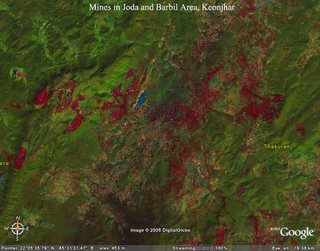 The area covered by the picture is approximately 400 sq. km. This is a true color picture. The blood red patches are the mines. The green patches are mostly forests. The dark patch visible near the bottom seems to be area polluted by sponge iron plants - though we need to confirm that.
This in another satellite picture of a site that is proposed to be leased out to Orissa Sponge Iron Limited for mining. The total area in the map is around 50 sq. km. The dark green patches are forests. The boundary of the mining lease is shown in yellow.There are number of perennial springs on the plateau which form the source of four-five perennial streams, vital sources of water for the local inhabitants. The local people are up in arms against the mining project.
 The Public Hearing for the Project took place Yesterday (31st Oct, 2005) and there was vehemant opposition from the local villagers and activists. As per our information, inspite of heavy police presence, more than a thousand people from nearby areas came all the way to Public hearing site at Kadakala village to protest. Apparently only 23 of these villagers were allowed to speak and submit memorandum. The local activists are planning to protest against this discrimination.
These are some satellite pictures of mines in Keonjhar and Sundargarh. They are from Google Earth. Quite scary!! But this is the tip of iceberg - the iron ore production from this area is slated to go up ten fold in next few years. These areas are also the home of Paudi Bhuiyans and Juangs, Primitive Tribal Groups of Orissa and come under Schedule V area.
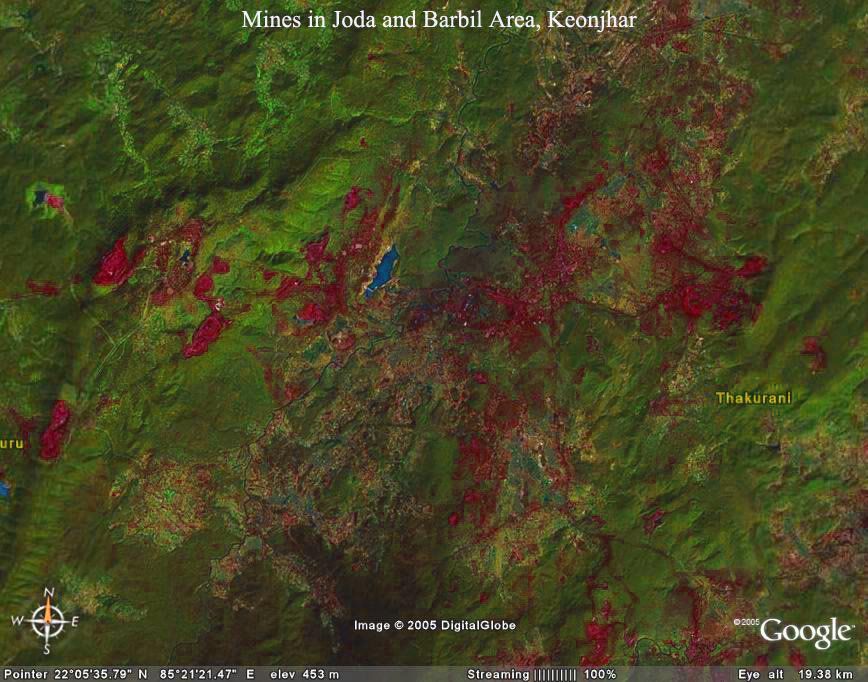 The area covered by the picture is approximately 400 sq. km. This is a true color picture. The blood red patches are the mines. The green patches are mostly forests. The dark patch visible near the bottom seems to be area polluted by sponge iron plants - though we need to confirm that.
This in another satellite picture of a site that is proposed to be leased out to Orissa Sponge Iron Limited for mining. The total area in the map is around 50 sq. km. The dark green patches are forests. The boundary of the mining lease is shown in yellow.There are number of perennial springs on the plateau which form the source of four-five perennial streams, vital sources of water for the local inhabitants. The local people are up in arms against the mining project.
 The Public Hearing for the Project took place Yesterday (31st Oct, 2005) and there was vehemant opposition from the local villagers and activists. As per our information, inspite of heavy police presence, more than a thousand people from nearby areas came all the way to Public hearing site at Kadakala village to protest. Apparently only 23 of these villagers were allowed to speak and submit memorandum. The local activists are planning to protest against this discrimination.
Subscribe to:
Posts (Atom)