A long article in ET on the Vedanta Niyamgiri issue.
Note the very last para - it quotes Vedanta as saying " “Even if they start exploring in other locations now, it will still take three more years before they can offer us mines. For that reason, Niyamgiri is a must for the refinery,” he said, adding that the company would force the state government “to fulfill the terms of the agreement they signed with us”.
They really think they rule the country.
Showing posts with label Vedanta. Show all posts
Showing posts with label Vedanta. Show all posts
Tuesday, April 13, 2010


Monday, March 15, 2010
NROs again
I had written about a certain set of NROs earlier at http://epgorissa.blogspot.com/search/label/Non%20Resident%20Oriyas
Then recently a threat started on a listserve regarding operation greenhunt. One certain Mr. Manoj Padhi, whose heart apparently beats for Orissa and Oriyas had the following words to say about Orissa's tribals
""The answer to all these tribals is - " (tax) Money is not hanging in trees of tribal regions" so that the Government can pluck them and provide them all kinds of comfort."
· Maintain status quo and worship their god Niyamraja
· flow with science & technology wind and "earn" development with their own income/ sales tax money, instead of looking at Government, if they don't agree with Government's version of development (like mining Niyamagiri Hill)"
The brilliance of this comment illustrates the gap that exists between NROs who stay in USA, drive their SUVs and dip in their swimming pools in backyards and the tribal Oriya whose daily income, if any, is half a dollar. It also shows the utter alienations and disconnect between such NROs and common people of Orissa. Of course, part of it is that these NROs have been part of Orissa’s elite, used to a feudal-castebased system, where tribals and dalits are seen less than human – and therefore it is easy for them to graduate to the arrogance of a right-wing Americanism. Lets see what Mr. Padhi has to add to the above words of wisdom.
Why ?
Why we don't buy land in a tribal area, where we can buy acres of land with in our budget?
For the same reason- why would any Businessman invest in tribal areas instead of Gurgaon, Faridabad and Noida ? Just to provide employment to tribals ? This is bad economics. Since you are against displacement of tribals, I guess, your vision of tribal development is - "Agriculture Only" === status quo
This was one of my choices. Tribals, if they don't want to be displaced, they have to live like that forever without expecting a share from the taxes of developed areas like BBSR, Berhampur or Rourkela.
Here is an analogy for Government vs Home owner Association. I live in a community, where the home owner association collects $300 per annum as HOA FEE. There are 1000 homes in the community and whatever they collect, would be spent for our community development such as swimming pool, club house, play areas, parks, walking trails.
There are other communities, with lesser homes - they collect $500 per annum for the same service. There are communities without swimming pools and they collect lesser amount. The point is - proportional service is offered by home owner associations, based on their income/fee collection.
Now apply this to tribals. They used to live in jungle by cutting woods, hunting animals - those are now illegal. Even Government has taken over "Kendu leaf" based income, which is used for "Beedi".
Now what's remaining for them ? Agriculture.
After independent, tribals were one of the biggest land losers as per the post-independence revenue records. Government is trying to correct the wrong by distributing them land pattas. So, without (sic!) negligible income (tax collection) from their region, what kind of Vision is possible ? They have to be parasites - i.e. depend on a share of tax income of developed cities/districts. Does center is able to distribute funds proportionately to states. No. Mamta Banarjee is taking 80% projects to Bengal. Lalu did the same for Bihar. Karunanidhi is getting more projects than Odisha.
And, without their negligible tax base, why would tribals expect that, the Government will channel others’ tax money to their area only ? Hence, any Vision without local tax income wouldn't be feasible and will die theoretical death. It sounds good to listen but won't be possible. Activists hate companies but NRGEA money is the result of 35% tax provided by corporate houses.
So, in short, in the absence of local tax money (please recall - lower the HOA fee, no swimming pool), there will be promises only from the Government. No quality of services.
But, if Vedanta comes and starts mining - local tax money will be generated and spent locally by their Municipality or corporation etc. Now, if they don't want to destroy the environment and wish to live like Amazon tribes, they are very much welcome. I will fully support their desire to live in the green belt provided, they don't want any thing from the Government's exchequer because they are not contributing any thing substantially to the Government's treasury.
So, let us drive Vedanta out and start a conditional signature campaign - "Mr. CM, leave us in our state and we want to live as Amazon tribe with the blessings of Mountain God Niyam Raja and we don't expect any thing from you - we are happy".
I love the arrogance of this man- comparing the State of Orissa to his Housing Association in some suburban city of USofA- the country of drone wars and long distance asssinations. I suppose for him the Maoists are “Taliban” with the beards shaved off, to be killed without any due process of law. Unfortunately for him – they still remain Indian citizens- though that doesn’t stop the government from killing them.
For him common people of Orissa, including tribals are parasites, existing on taxes of middle class and the corporate houses. Does he know by what means the Government of India (sorry the imperial british) obtained “rights” over the mineral and forest resources of tribal India? Does he know about the wars of resistance fought by the tribal communities – whose lands and forests have been sought to be taken away? Does he know about enclosures of commons- not only in India’s hinterland but also in the Americas.
I have a question to ask the NROs- is Mr. Padhi and his ideas representative of standard NRO thinking? Are all of you so out of touch with the reality of Orissa- or is this person an aberration, and outlier, a statistical anamoly. Can anyone respond to this?
I am also copying a response to stuff like this which I posted on the said listserve. The post was in support of Prashant Patanaik, the veteran journalist from Orissa, who pointed out that people who were screaming hoarse about the employment corporate houses would provide are silent about the nearly one lakh vacant posts in government jobs.
This was my post
“the self-same intellectuals will than add - but government doesn't have the resources to employ one lakh people. Then you could point out that we are selling off our best quality iron ore, manganeses and bauxite for peanuts so that the miners and industrial houses can be subsidised - and that literally hundreds of thousands of crores of rupees have been siphoned off from the collective wealth of Orissa by the same companies and individuals who are being supported by the diaspora. You could also point out that inspite of the manyfold increase in mining output, the employment in mining sector has fallen over the years. And that the employment that these new industries would bring in is miniscule compared to the people they are displacing- and that this employment will go to the well educated people, mostly non-Oriyas. We could tell them that in the current situation, Orissa is being looted, legally and illegally, and that its only these movements who are trying to do something about it- and that almost everybody else with power and voice has sold out to outsiders.
In the larger picture, we could point out that zones of intense natural resource extraction have never benefitted from the same- maybe the example of Appalachia mountaintop mining or iron ore mines in Upper Peninsula of Michigan will help to convince Mr. Padhi. We could point out that such zones have almost always led to undemocratic governments and that in literature this affliction is called "resource curse" - countries like South Africa, Namibia, Sierra Leone, Congo, Bolivia, Peru, Iraq.”
We could point out the slums of Jamshedpur and Rourkela, where you can find the original "tribal" inhabitants of these areas- living in misery. We could point out that Rourkela, Jamshedpur, Koraput are outposts of internal colonisation.
We could claim that those who speak against Green Hunt and have approached the SC against Salwa Judum are not supporting Maoists - that in fact the naxalites, when they come to power (an impossibility), would be as vicious and cruel as the current dispensation, with their belief in a static ideology. That probably the first people that the armed revolution will target are the same "intellectuals" that one of the poster called "agents of China" for speaking out for the human and democratic rights of the poor.
We could point out that the process of creative destruction of capitalism implies that surplus populations sitting on resources needed by the powerful will be extinguished - and that development no longer means the development of everyone in India and Orissa- but the development of a vocal, powerful minority of Indians. That this planet doesn't have the resources to support a billion Indians to live in the same lifestyle that Mr. Padhi enjoys - and that his swimming pools and manicured lawns are "unprecedented" in human history - and that these are sustained by resource exploitation on a totally unsustainable and extractive basis. That the modern systems of wealth have been built on the destroyed lives of hundreds of people and unprecendented resource grabbing; and that what we see in Orissa is the continuation of the same processes. We can also point out that we are fast running out of resources that fuel his consumption life style.We may point out that the same processes which sustain his swimming pool and american lifestyle are also destroying our livelihood support systems, including our atmosphere.
However, all these would fall on deaf ears of those in the diaspora who are the multiple beneficiaries of the which grinds our people to dust. They were privileged when they were in Orissa- fattened by the cheap labor and cheap resources of their fellow citizens. And then they are privileged by the same processes of global circulations and extractions which allows them to maintain their swimming pools and SUVs in the US of A. They have transitioned smoothly from the privileges of feudal-caste society of Orissa to the capitalist societies of the west.
And then they have the gumption to advise people and their movements here- at the receiving end of all these processes - to support the same anti-democratic and anti-people entities to rape and ravage our land, treating our people as so much filth to be kicked out from their lands and livelihoods.As Satyasagar pointed out, Indian elite, unlike the western elite, doesn't consider the three fourth population of our country as human- and therefore denies their basic human rights. How can the diaspora (though with many exceptions), which has spawned from the same elite, be expected to think of the majority of Oriyas, including tribals, as human beings having certain basic rights. They dream of a glorious, utopian Orissa- yet this dream is an upper class/caste/diasporic nightmare/dream, where the poor don't exist- not because they have been "uplifted", but because they have been decimated or made invisible.
Let us stop paying attention to them - those who dream of Vedanta Universities and the shining metro of BBSR, built on the bleached lives, destroyed livelihoods and extracted labor of our people. The struggles of people for their rights and justice is too important to waste time with these long distance advisors.”
Nachiketa
Thursday, July 23, 2009
Vedanta steps in it again
Vedanta, the company who wants 6000 acres for a piddly university (my own institution University of Toronto's main campus is around 200 acres only with a student population of nearly 70,000) shows its real, irresponsible face again. This time- surprise, surprise - it is our Pollution Control Board- which has issued a show cause notice to Vedanta's massive aluminium smelter and power plant in Jharsuguda. I wonder how a company which can't manage its ESP and ETP can claim to propose to run a world class University. Or maybe it is too costly to even meet the paltry standards demanded by the Pollution Control Board.
Its also nice to see one newspaper and a reporter who is willing to report the reality about Vedanta. I hope this will continue.
The link for the news article is
Pollution Control Board slaps notice on VAL
The New Indian Express
First Published :
Last Updated :
It was also found that rectification of ESP system toreduce emission levels had not been undertaken nor land for construction of permanent ash pond acquired. Moreover, conventional method of transportation of ash slurry was being followed and a breach in the dyke of ash pond had occurred posing serious threat to both the ash pond and the nearby Kharkhari nullah.
It was also found that Effluent Treatment Plant (ETP) of the smelter plant was not commissioned and effluent was released into Kharkhari nullah without any treatment to contain fluoride which was in excess of the prescribed limit. Environmentally sound practice was not followed towards handling and management of fluoride contaminated hazardous waste materials posing threat to surface run-off contamination during monsoon.
Several lapses like bad house-keeping in Coal Handling Plant (CHP) area, absence of proper handling system for bottom ash, existence of bypass water pipeline near recirculation of cooling water of a cast house, non- existence of garland drains in carbon area, no plantation alongside the plant boundary in carbon area, tardy progress towards construction of secured land-fill site, continuance of ash dumping at the bank of Kharkhari Nullah and non-installation of sewage treatment plant for treatment of domestic waste were also observed contributing to the problems of pollution.
The same problems existed when the SPCB officer visited the plant again in the first week of July. Maintaining that VAL has grossly failed to implement the action plan submitted by it to contain pollution, the SPCB has sought a reply in the stipulated period and if not found satisfactory action under appropriate provisions of Water (PCP) Act and Air (PCP) Act will be initiated. VAL has also been offered personal hearing on July 23.
Monday, July 13, 2009
Latha Jishnu: Killing them ever so softly
A good piece on Vedanta, its Lanjigarh refinery and pollution in Business Standard
| Latha Jishnu: Killing them ever so softly |
| Latha Jishnu / New Delhi July 11, 2009, 0:33 IST |
Widespread pollution by the Vedanta refinery in Orissa raises serious questions about environmental monitoring.
At first sight the images are picture perfect. There are gurgling streams, a rushing river, a tree-dotted landscape, all of which are partially covered in snow, the kind of destinations tour operators peddle every summer. Then you see scruffy village children and buffaloes ploughing through the white stretches and kicking up a lot of dust and you realise that something is amiss. As the camera zooms in, reality comes as a shocker: This is Lanjigarh in Orissa’s Kalahandi district where snow is as unlikely as apple blossom in Rajasthan. The thick white crust covering the Vamsadhara River and blanketing the surrounding villages is fly-ash — layers and layers of it, the soft, choking dust settling into heavy deposits that have scarred the topography and made life a living hell for people in the area.
These are shots from a documentary that has caused quite a furore in recent weeks. Sham Public Hearing — The True Face of Vedanta is a narrative of the environmental problems that have ensued after metals and mining behemoth Vedanta Resources (2009 turnover: $6.6 billion) set up an alumina refinery in Lanjigarh block of Kalahandi district three years ago. The one-million-tonne refinery along with a 75-MW power plant comes under Vedanta Aluminium Ltd (VAL) which describes its Lanjigarh facility as one of the world’s premier alumina plants “in terms of its technology, human resources and high quality infrastructure”. It also boasts that the refinery is the only zero-discharge plant of its kind in India.
On June 1, VAL was marking a special triumph. It announced that it had bagged the ‘prestigious’ Golden Peacock Award 2009 instituted by the UK-based World Environment Foundation (WEF) in association with Institute of Directors. The selection had been made by a jury of worthies headed by no less than P N Bhagwati, a former Chief Justice of India and member of the UN Human Rights Commission. The award, the company said, “recognises Vedanta’s efforts in setting high standards” in its environment management.
The celebration turned out to be premature. Barely a week later, The True Face of Vedanta, made by Bhubaneswar-based filmmaker Surya Shankar Dash, ripped apart this image. Apart from the environmental degradation, the documentary records the effects of pollution on the hapless villagers. Some of its sharpest images are of the very young victims of pollution — children with all kinds of skin diseases, from suppurating sores and boils to rash, which is on the rise in the area.
No one is certain why the disease is affecting villages like Bundel, which are on the periphery of the refinery. Local residents say the problem is of recent origin and comes from bathing in the river or drinking its water. The probable cause is the seepage of highly alkaline and caustic water from the waste ponds into the Vamsadhara and its nearby streams. The Orissa State Pollution Control Board (OSPCB) has repeatedly brought this to the notice of VAL but despite several show-cause notices the company appears to have been unable to check the contamination.
VAL is dismissive of such charges. Its standard response is that it has adopted the zero discharge system in which no waste/effluent is released outside the plant or red-mud pond or fly-ash pond. A VAL spokesman is categorical: “There is also no contamination of any natural stream or river due to discharge of fly-ash,” he says. As to the photographic evidence of fly-ash covering the streams and villages around the factory, he insists “it is of the inside disposal system of the fly-ash pond”.
Dash refutes this. “You can clearly see the shots are of the river, not of the inside,” says the filmmaker. “You cannot go anywhere near the refinery because the security guards will follow you and try to snatch your camera.” Corroboration of what the film reveals can be found in official documents if one goes looking for it. The OSPCB’s inspection reports are a damning indictment of the way Lanjigarh refinery has handled its wastes since inception. From November 2007, that is barely three months after the refinery started trial operations, OSPCB inspectors have been cautioning VAL about the seepage of contaminated water into the river. Even a January 2009 directive asks the company to set right the leakage of caustic water from its pipelines and to stop the discharge of contaminated water into the Vamsadhara. The reports also highlight the recurring problems that VAL has had with the maintenance of its ash and red-mud ponds, the latter, a lethal effluent of bauxite.
The litany of lapses/defects in the company’s pollution control systems should have occasioned serious disquiet in official circles. But instead of penalties there has been reward. “OSPCB has given us consent to operate up till March 2011,” claims a company spokesman because of the board’s “satisfaction on our environmental measures”.
The bigger irony is that OSPCB has allowed VAL to expand capacity to six million tonnes which will make it the largest refinery of its kind, globally. This is a clear coup for Anil Agarwal’s London-based FTSE 100-company which has been battling a sustained campaign in India and the UK against the Lanjigarh complex. The problems of such aggressive expansive can be gargantuan. Working at just 70 per cent of its current capacity, that is 700,000 tons, the refinery produces 500 tons of fly-ash daily along with 2,500 tons of red-mud, all of which is supposed to be released into their respective ponds. But there is leakage and seepage into the groundwater, as OSPCB strictures show.
Villagers allege that whenever the pipelines carrying the wastes are choked the pipes are cut and effluents released into the streams. At the Belamba public hearing on April 25, OSPCB officials remained mute when over two dozen villagers, many of them from the Dongria Kondh tribe, gave bitter testimony about the effects of the red-mud pond and fly-ash pollution in the vicinity of the refinery. Kumuti Majhi of Sindhuali village said that he was jailed for several weeks for complaining about the pollution. The brooding anger and despair is widespread among the villagers in Lanjigarh and not a single official responded to the repeated charges of the health hazards posed by the refinery.
The True Face of Vedanta has acted as a rallying point for over a 100 global voluntary agencies and activists who have forced WEF to put the award on hold. VAL appears unfazed. “We are expecting the award very soon,” says the company which is preparing for its biggest challenge — the commencement of mining operations in Niyamgiri Hills in the face of entrenched opposition from the Dongria Kondh.
As the company gears up for confrontation with the outraged tribe which considers the hills sacred and the source of their sustenance, the state is providing a helping hand. Bauxite mining will be carried out by the Orissa Mining Corporation in partnership with Vedanta’s sister concern, Sterlite Industries India, under a Supreme Court order aimed at deflecting international censure of Vedanta. Close to 700 hectares has been leased to the joint venture for the mining. However, environmentalists have made a last-ditch attempt to stall the desecration of Niyamgiri. R Sreedhar, director of the Academy of Mountain Environics, which is a trust promoting sustainable development solutions, has petitioned the National Environmental Appellate Authority to quash the mining clearance in view of the many regulatory violations by the company. The petition is scheduled to be heard on July 21 but there appears to be little hope of a reprieve for the environment.
Saturday, June 13, 2009
Activist protest Golden Peacock award by WEF to Vedanta Alumina in Himachal
 http://himachal.us/2009/06/12/activist-protest-golden-peacock-award-by-wef-to-vedanta-alumina-in-himachal/13576/news/rsood
Posted by Ravinder Sood on Jun 12th, 2009 in Environment, News.
(The post has been borrowed from the site My Himachal (http://himachal.us/))
PALAMPUR: Twenty activists representing environment and social action groups today barged into the World Environment Foundation’s (WEF) opening ceremony of the ‘Global Convention for Climate Change’ being held at the Palampur Agriculture University grounds with posters and banners screaming “Stop greenwashing corporate crimes” and “Stop selling climate change”. The activists were protesting against the WEF’s Golden Peacock award to the Vedanta Alumina Limited for its refinery in Lanjigarh Orissa. The protestors gathered in front of the stage after a tussle with the organisers managed to seize the stage the microphone, and highlight the various environmental crimes and human rights violations that the company has indulged in not just in its Orissa project but other project sites across the country.
The activists briefed the Tibetan Prime Minister in exile – Samdhung Rinpoche, who was present as a Chief dignitary at the function about the national campaign that has built up against the company and the devastation cause by the company in Orissa. He immediately walked out of the venue at this point. Subsequently, hundreds of children from schools In Palamapur, present at the ceremony, who cheered as the protest gathered momentum, also left the venue. Delegates of the conference at the venue were also given pamphlets as well as the letter written to the jury, endorsed by more than 170 organizations, asking for the withdrawal of the Golden Peacock to Vedanta.
In January 2009, WEF withdrew the Golden Peacock Award given to Satyam Computers, literally days before the company submitted its fraudulent balance sheet to shareholders. “We do not expect any integrity from the organizers of the Golden Peacock Awards. However, many of the jury members are persons of good reputation and integrity. We are concerned that your decision may have been arrived at in the absence of full information. We would also like to give you an opportunity to review some disturbing information regarding the conduct of Vedanta and its subsidiaries, and to dissociate yourselves from the award to Vedanta to avoid a Satyam-style embarrassment,” endorsers to the letter to jurors wrote.
Guman Singh, leader of Himalaya Niti Abhiyan who spoke on behalf of the campaign appreciated that Chief Minister of Himachal who was to be the Chief guest at the function had withdrawn his participation from the event after pressure from the campaign and the controversy around awardee company. Mamata Dash, an activist from Orissa tried to draw the attention of the delegates towards the crimes committed by Vedenta on the Dongria Kondh adivasis in the Niyamgiri hills for its bauxite mines. Just as she began speaking Madhav Mehra, founder of WEF, tried to shove her off the stage. After a scuffle with the activists, Mehra made a statement that he had no interest with Vedanta and that they would review the award and even withdraw just like they had done in the Satyam case if the facts were found to be true. As the tussle continued between the activists and the organizers, the ground echoed with slogans like “WEF down down” and “Vedanta company chor hai!”. As the protestors left the venue, to save his face Madhav Mehra tried to trivialize the issue and only spoke of all the “good work” done by Vedanta.
Monday, March 23, 2009
Catching Up
So much to write about. There has been a hiatus of almost three years since the blog was active. Much water has flown under the bridge during these three years. The Supreme Court provided clearance to Vedanta to mine Niyamgiri; POSCO still continues to be stymied in Jagatsinghpur; Kalinganagar people still continue to hold strong against the TATAs. We had the Kandhmal riots against Christians and the break up of the alliance between BJP and BJD; internationally we are still blinking at the rapidity of the collapse of the neo-liberal bubble. A black man became the president of USA, and continues with the neo-imperialist policies of the Bush the Younger. We lost one of the most important activists in Orissa, Mr. Rajandra Sarangi, to cerebral malaria, a sore loss which continues to hurt all those who love Orissa.
We also have Professors from abroad advocating for industrialisation and displacement - NROs for "Corporations" and "Growth". More of that later.
At this point, I would like to inform you that Survival International has put a beautiful documentary on the Donagria Kondhs and Niyamgiri (and of course Vedanta) on its website at http://www.survival-international.org/films/mine . Please have a look at it - a poignant reminder of what is being lost in Vedanta's lust of bauxite. Professor Sahebs, aapan mane bhi dhekantu, this relates to the same company which is promoting Vedanta University.
Kundan
Trouble in Niyamgiri
The latest on this is that it is not clear whether anyone has died or not. But the situation is dire and will be used to prosecute the Dongarias
Dongaria Kondhs provoked by Vedanta Goons- one person probably dead
Reported by Surya Shankar Das
On the 18th of March, a motley group of contractors, mafia men, local supporters of Vedanta, etc. managed to get to the Niyamgiri hilltop on a SUV and a mobike. There they had an argument with Dongria Kondhs who fobade them from entering their sacred grove. The men did not heed their words and a clash between both groups became inevitable. The Vedanta men were beaten up badly and their vehicles were torched. One of them also suffered from serious injuries from axe blows. He was admitted in a hospital where he seems to have succumbed to the injuries two days later. This is an unfortunate fallout, that the people have been pushed to this extent. Their repeated pleas to the world has been repeatedly ignored by the company and state. Now they have been forced to use the axe which they had very clearly said they would if the need arises. While things have come to the point where they did use the axe, this will give the state police very good alibi to create a new phase of repression. People will be arrested, framed on false charges, And if that does happen a bigger casualty than Kalinga Nagar cannot be ruled out. If it doesnt happen while the elections are on then it will definitely happen when it is over. My sources have been informing me for more than a week that the mafia has been aggresively campaigning in villages like Kadamguda, Balabhadrapur, etc and they had even managed to dismantle the barricade in spirit at least. Road construction had begun and many villagers had been bought over to the company side. While all this happens at the ground Vedanta's press releases have been splashed all over the media. My sincere appeal to everyone to join hands and counter the media assault by Vedanta as well as find ways to protect the Dongrias from being pushed into such extreme situations where they have to wage medival wars to protect their home, habitat and religion.
Dongaria Kondhs provoked by Vedanta Goons- one person probably dead
Reported by Surya Shankar Das
On the 18th of March, a motley group of contractors, mafia men, local supporters of Vedanta, etc. managed to get to the Niyamgiri hilltop on a SUV and a mobike. There they had an argument with Dongria Kondhs who fobade them from entering their sacred grove. The men did not heed their words and a clash between both groups became inevitable. The Vedanta men were beaten up badly and their vehicles were torched. One of them also suffered from serious injuries from axe blows. He was admitted in a hospital where he seems to have succumbed to the injuries two days later. This is an unfortunate fallout, that the people have been pushed to this extent. Their repeated pleas to the world has been repeatedly ignored by the company and state. Now they have been forced to use the axe which they had very clearly said they would if the need arises. While things have come to the point where they did use the axe, this will give the state police very good alibi to create a new phase of repression. People will be arrested, framed on false charges, And if that does happen a bigger casualty than Kalinga Nagar cannot be ruled out. If it doesnt happen while the elections are on then it will definitely happen when it is over. My sources have been informing me for more than a week that the mafia has been aggresively campaigning in villages like Kadamguda, Balabhadrapur, etc and they had even managed to dismantle the barricade in spirit at least. Road construction had begun and many villagers had been bought over to the company side. While all this happens at the ground Vedanta's press releases have been splashed all over the media. My sincere appeal to everyone to join hands and counter the media assault by Vedanta as well as find ways to protect the Dongrias from being pushed into such extreme situations where they have to wage medival wars to protect their home, habitat and religion.
Tuesday, December 06, 2005
Dongaria Kondhs come to Bhubaneswar, Public Hearing for Vedanta Aluminium Smelter,High Court bowls for mining corporates etc.
Marriage in the family, so I was too busy to blog till today. Many interesting developments have taken place during the last few days. Dongaria Kondhs came down from Niyamgiri hills to Bhubaneswar to hold a rally against Vedanta. A public Hearing for the Vedanta Aluminium Smelter proposed at Brundamal near Jharsuguda is being organised on 9th December by the Orissa Pollution Control Board, inspite of the Vedanta Alumina refinery being sub-judice.
The Orissa High Court struck down the attempt of the Orissa Government to impose a mineral cess, saying that it violated the constitution. This will mean that the mining corporate mafia will make Rs. 1300 crores more every year (I am sure that is an underestimate). I wonder if the High Court has ever thought about the constitutional rights of the Scheduled Tribes whose lands are being acquired in violation of the Schedule V and the Orissa Scheduled Areas Transfer of Immoval property Regulation, 1956, for the profits of the same mining company. Many people point out that the act seems to have been deliberately worded in order to make the High Court strike it down, allowing the mining company friendly state government to blame the judiciary (saanp bhi mar jaye, lathi bhi na tute). Maybe someone could enlighten us on that.
There was a massive rally in Kalinganagar against displacement by more than 5000 tribals recently. Another large meeting was held against POSCO yesterday near Paradeep against the proposed steel plant. In Kashipur, more than 20 tribal anti-mining activists continue to languish in the jail. Rabindra Jarika, one of the leaders of Kalinganagar movement against industries still continues to be in jail.
Meanwhile, today there were some questions in the Assembly about the industrialistion process, most MLAs asking about the progress of the industry MOUs. One MLA did ask how Bhushan Steel has managed to start its project without obtaining Forest Clearance from MOEF, but the mining Minister cleverly avoided answering this question. The show goes on.
An article on Vedanta in Telegraph is a must read - I have provided it in the end of today's post.
Dongaria Kondhs come to Bhubaneswar

Here is the coverage in Statesman of the Dongaria Kondh Rally in Bhubaneswar on Dec. 5th
Tribals’ protest against Vedanta
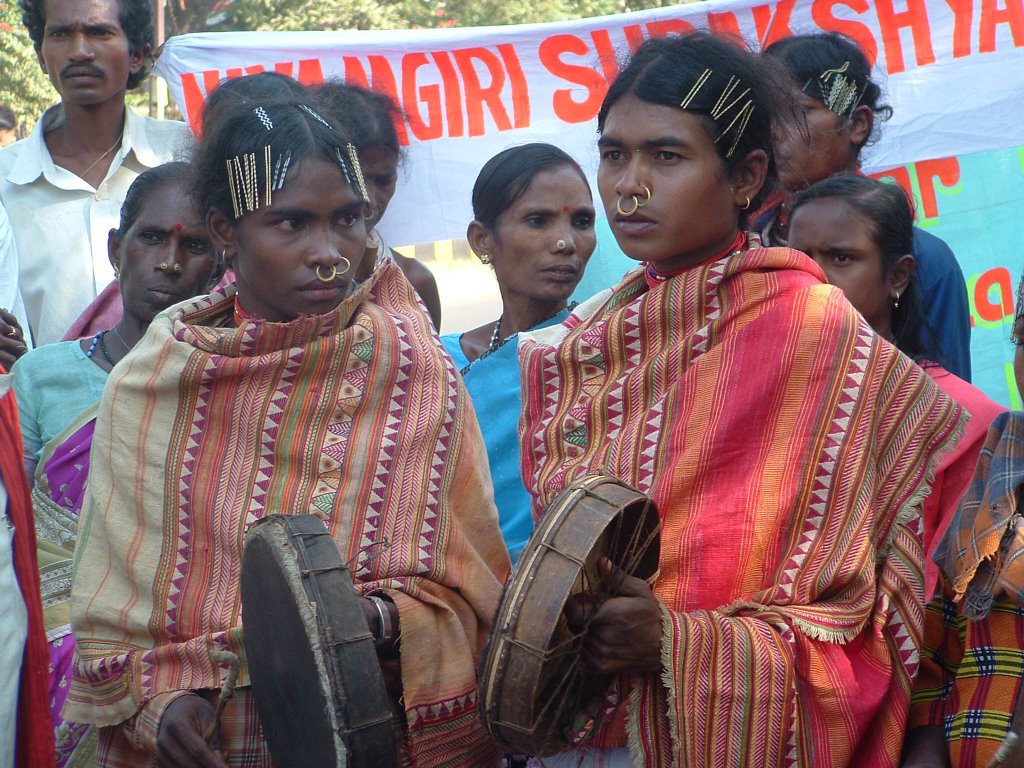
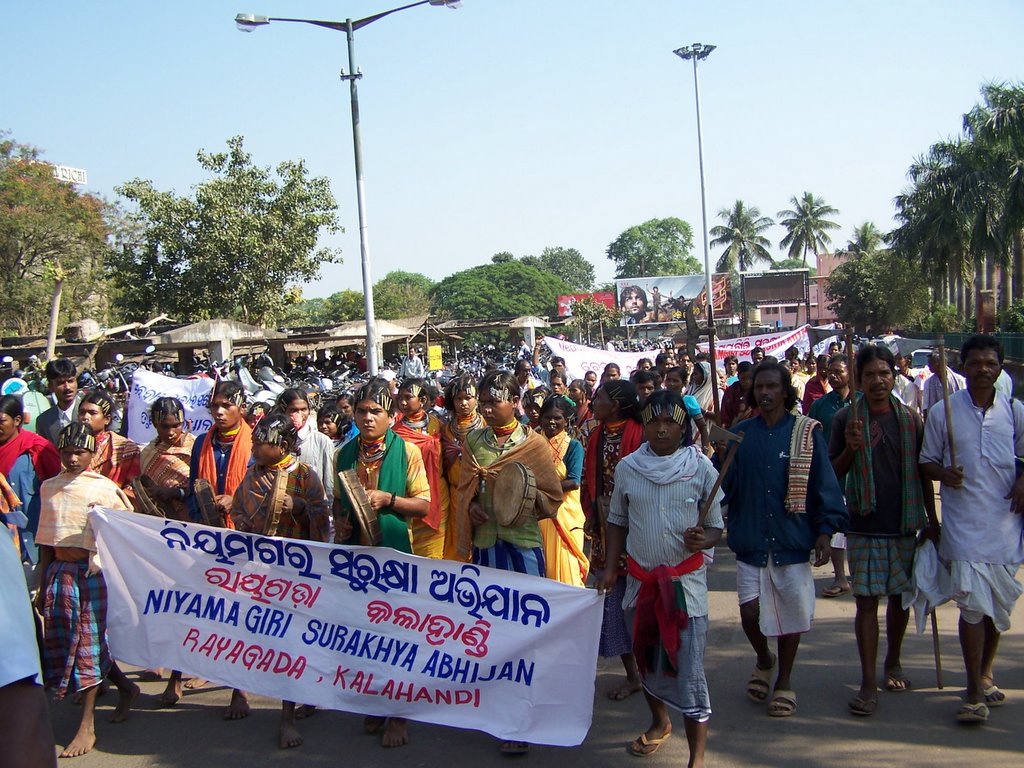
Statesman News Service BHUBANESWAR, Dec. 5. — Hundreds of tribals from Rayagada and Kalahandi districts today staged a demonstration in front of the Assembly urging the state government to shelve the proposed alumina plant and bauxite mining project in Lanjigarh area in compliance with the recommendation of the Central Empowered Committee of the Supreme Court. They threatened to continue their movement in exchange of their lives till this “anti-people’’ and “anti-environment” project was withdrawn. The Vedanta Alumina Limited, a joint venture company of Sterlite and the state government, is setting up an alumina plant and a mining project in Lanjigarh area, amidst protest from local tribals, environmentalists and Opposition parties. Dressed in their traditional attire and armed with traditional weapons tribals from the affected areas took out a rally and staged a demonstration in front of the Assembly. The demonstrators were shouting slogans and singing songs in Kui language accompanied by traditional musical instruments. Leaders of the Niyamgiri Suraksha Abhiyan, which is spearheading the anti-alumina plant agitation, said that the proposed project would not only displace thousands of local tribals, depriving them of their livelihood, it would also destroy the fragile eco system of the Niyamgiri hills. The Vanshadhara and the Nagabali rivers emerging from the hills would dry up, leading to drying up of the command area. Rich flora and fauna on the hills would vanish. The primitive Dongria Kondh living in the Niyamgairi hills would be greatly affected, they alleged. The state government has shown undue favours by allowing the Vedanta company to set up an alumina plant and leasing out the bauxite mines in violation of forest laws despite protest from local Dongria Kondhs, they alleged adding that the company and the state government had initiated repressive measures on the agitating tribals. Despite the Central Empowered Committee’s recommendation to stop the project, the state government was forcibly carrying on land acquisition and conniving with the company in its illegal activities, charged the tribals."
Here are some photographs of the rally (courtesy self):


Public Hearing for Vedanta's Aluminium Smelter
Despite the CEC stricture and the fact that their alumina refinery case is sub-judice with the Supreme Court, Vedanta and State Pollution Control Board are going ahead with the hearing on 9th December. Apparently a legal notice has also been served by Mr. Ritwick Dutta on behalf of the petitioner in the case. I just hope that there is strong enough opposition against this smelter and its power plant (5X135 MW), coming up near Hirakud reservoir. This plant would be a tragedy, not only for the displaced (mostly tribals who are cultivating government land, and hence would receive no compensation) but also for the ecology and environment of the Sambalpur region, coming on top of the steel and sponge iron companies which already exist or are under construction. It will also block the connection between Badarama/Ushakothi sanctuary and the vast forests on the North West of Hirakud reservoir. And aluminium plants are notorious for fluoride pollution - one only needs to ask the residents near NALCO's Angul Plant or Hindalco's plant near Hirakud.
The situation in Sambalpur-Jharsuguda belt is rapidly spinning out of control, and I will devote a future posting for the same. However, Sambalpur people really need to wake up - or they will find their land and water poisoned irretreivably. Some people tell me that the apathy in the area is because most of the land is owned by large farmers, who stand to become millionaires with the land compensation. These people provide the local leadership and are on the side of the companies - and the poor and landless who really suffer from displacement have little voice. Its hightime someone got down to organising the people who are really losing out.
High Court Bowls for Mining Companies
Article in Telegraph, Calcutta
Sunday, November 27, 2005
The Vedanta affair- The nub of the CEC’s report is the issue of forest land NRI tycoon Anil Agarwal expanding his metals empire. But in a remote corner of Orissa, he faces a firestorm that could derail — at least temporarily — his ambitious global gameplan, report Debabrata Mohanty and Anirban Das Mahapatra
The concrete pillars of the conveyor belt for carrying the bauxite ore at Lanjigarh Businessman Anil Agarwal’s is a rags to riches story come to life. He started out in his late teens as a scrap metal trader from Bihar. Today, he’s a billionaire who has almost achieved his ambition of being a key player in the global metals market. His firm, the $1.8 billion Vedanta Resources, is listed on the London Stock Exchange and Agarwal operates from a swanky office in London’s exclusive Mayfair district.
But in a remote corner of Orissa, in one of India’s most backward regions, Agarwal is facing a firestorm that could derail — at least temporarily — his ambitious global gameplan. Several months ago, Agarwal, who’s better known in India as the hardscrabble businessman who built Sterlite Industries, began working round the clock on an $800 million (Rs 3,657 crore) project that includes a giant aluminium refinery and a bauxite mining unit. Bauxite is the raw material used to make alumina, which in turn is converted into aluminium. Incidentally, bauxite prices are currently at a record high internationally. Some $247 million (Rs 1,129 crore) of the $800-million project, which is scheduled to be completed in 2006, has already been spent, according to Vedanta’s website.
But in September a five-member committee appointed by the Supreme Court, called the centrally empowered committee (CEC), submitted a report to the court recommending that the court revoke the environmental clearance granted for setting up the refinery and that Vedanta be directed to stop further work on the project. A ruling is expected in December.
At stake are thousands of crores and the possibility that the project might become unviable if the Supreme Court rules against Vedanta. Against that is the committee’s position that Vedanta has not quite met environmental regulations.
The CEC is a quasi-judicial body the Supreme Court set up in 2002 to look into forest and environment issues. Biswajit Mohanty of the Wildlife Society of Orissa filed an application before the CEC in November 2004 against Vedanta. Environmentalist Prafulla Samantara and a Delhi-based geologist, R. Sridhar, subsequently filed two other applications. The CEC clubbed them together in December and then sent a fact-finding team —which was one of the prayers of the litigants — to the region. The hearings started in February.
In May, Vedanta went to the Supreme Court, asking it to quash the proceedings. But the court ruled that a decision would be taken after the CEC gave its report. The CEC itself visited the area in June this year. It completed and submitted its report in September.
Anil Agarwal is in a piquant position. The refinery’s construction has already begun, but he confronts the prospect of the Supreme Court nixing the project. Vedanta, meanwhile, has not exactly been sitting idle either. Last week, it was set to file a petition in the Supreme Court supporting its position, according to a source at Vedanta subsidiary Sterlite Industries (India).
Among other things, the environmentalists had accused Vedanta of having started work on the projects before environmental clearance had been obtained, something Vedanta has strongly denied. “Some areas of our state which are extremely rich in bio-diversity are sacrosanct and should not be touched. You cannot dig up and mine anywhere you please,” says Biswajit Mohanty, previously known for his campaign to save the endangered Olive Ridley turtles.
Indeed, Anil Agarwal is in a piquant position. The refinery’s construction has already begun. While Sterlite Industries declines to disclose precisely how much money has been spent separately on the bauxite and refinery projects, Agarwal has spent at least 45 per cent of the project’s cost, according to the environmentalists — and confronts the prospect of the Supreme Court nixing the project. Secondly, the project’s alumina, an intermediate product used to make aluminium, will feed Balco’s expansion (half the alumina will go to the group’s captive aluminium plants and about half would be sold to third parties, Agarwal recently told Vedanta shareholders).
What happens if the Supreme Court rules against Vedanta? The London-based company could look at other bauxite ore deposits elsewhere in the state (Karlapat, Kutrumaili, Sasbahumali and Sijimali, for example) or source bauxite from elsewhere. The company told the CEC that if the mineral from the Lanjigarh mine were not available it would obtain bauxite from other sources. But rivals in the aluminium industry argue that this will push up costs. “In projects such as Vedanta’s, the money is mostly paid in advance to sub-contractors,” says a highly placed source at the government-owned National Aluminium Corporation. “So if the Supreme Court bars the company from digging up the Niyamgiri bauxite reserves and asks it to identify an alternative mine, the cost of production and transportation will shoot up and make the project unviable.” Sterlite Industries officials deny this.
Vedanta’s Orissa projects are being implemented by Indian subsidiary Vedanta Alumina Company and comprise a mine near the Niyamgiri hills — which boast of a rich deposit of bauxite — and a refinery at nearby Lanjigarh. The mine area is said to have 150 million tonnes of bauxite, according to the Vedanta web site (75 million tonnes, according to the CEC report) and the project, says the CEC report (a copy of which The Telegraph has), proposes to source three million tonnes of bauxite every year from the mine. As part of the Orissa government’s efforts to develop the region, the state-run Orissa Mining Corporation (OMC) inked a joint venture with Vedanta Alumina for setting up the refinery at Lanjigarh and for the mine. The Vedanta group planned on setting up a 90 MW captive power plant at the site to supply power. The 1.4 million tonnes per annum refinery will initially produce one million tonnes of alumina.
The area is part of Kalahandi, one of India’s poorest districts and infamous across the world for its starvation deaths. Endowed with a green canopy and with fresh-water streams, the unspoilt project area is home to several vulnerable animal species, as many as six of which find a mention in the red data book of the International Union for the Conservation of Nature and Natural Species (IUCN). Besides, a handful of the critically endangered, 6,000-strong Dongaria Kondh tribe live a rudimentary life in the folds of the mountains.
If and when the project gets going, the environmentalists argued before the CEC, it would have many consequences: liquid and gaseous effluent emissions, bright illumination, drilling and the resultant vibration and dust and pollution could affect the flora, fauna, ecology and human population of the area.
The issues involved are complicated, but the nub of the CEC’s report is the issue of forest land — that the MoEF granted environmental clearance for the project on September 22, 2004, on the assumption that no forest land was involved. But at that time a proposal to use nearly 59 hectares of forest land for the refinery had been pending with the ministry. Another proposal to use over 672 hectares of forest land for the mine project is now pending with the ministry.
Much of the argument is centred on the fact that construction of the Vedanta project required the diversion of the 59 hectares of forest land, comprising about 29 hectares of village forest land and about 30 hectares of reserve forest. Company officials say that the land was part of their earlier calculations, but it was out of “abundant caution” that the refinery was finally proposed to be built entirely on non-forest land. The 30 hectares of reserve forest land were apparently diverted to the mining project, for building conveyors and approach roads, for which forestry clearance is still pending.
But the CEC claimed that Vedanta did not disclose the involvement of forest land in the project. Apparently, in June 2002, the collector of Kalahandi district issued a notice for acquiring land for the alumina refinery project, which showed that 118 acre of village forest land was involved in the project. “That effectively indicates that forest area was very much included in the project even before it kicked off,” says a CEC source.
When Sterlite applied for environmental clearance to the MoEF, it said that no forest land was involved in the project and that there was no reserve forest within a radius of 10 km, the CEC report said. Then, in August 2004, the company — in seeking forest clearance — put forward an application for the use of about 59 hectares of forest land. However, the application for the environmental clearance was not modified and was processed on the premises that no forest land was involved.
The MoEF’s actions have been questioned by the CEC as well. “The environmental clearance for the alumina refinery could not have been accorded without taking a decision on the mining component which is an integral part of the project,” notes the report, adding that at the time of granting environmental clearance, “even the proposal under the Forest Clearance Act for the use of forest land for the Niyamgiri bauxite mines had not been filed with the MoEF”. Prodipto Ghosh, secretary, MoEF, refused to comment on the issue, citing its sub-judice status.
Vedanta, in turn, pointed out to the CEC, among other things, that the environmentalists who objected to the project did not attend the public hearings on the projects in February and March 2003 but raised issues after the projects reached a critical state. It also said that it had fully disclosed in documents that forest land lay within a 10 km-radius of the project site, and that it had disclosed that the alumina refinery is located at the foothills of the Niyamgiri hills. “The fact that Niyamgiri hills are reserved forests has been abundantly disclosed in the EIA report,” it said.
The Supreme Court will, undoubtedly, decide on the truth of all these matters. Till then, the man from Bihar who made his millions in Mumbai and now operates out of London’s tony Mayfair will live on the edge.
Marriage in the family, so I was too busy to blog till today. Many interesting developments have taken place during the last few days. Dongaria Kondhs came down from Niyamgiri hills to Bhubaneswar to hold a rally against Vedanta. A public Hearing for the Vedanta Aluminium Smelter proposed at Brundamal near Jharsuguda is being organised on 9th December by the Orissa Pollution Control Board, inspite of the Vedanta Alumina refinery being sub-judice.
The Orissa High Court struck down the attempt of the Orissa Government to impose a mineral cess, saying that it violated the constitution. This will mean that the mining corporate mafia will make Rs. 1300 crores more every year (I am sure that is an underestimate). I wonder if the High Court has ever thought about the constitutional rights of the Scheduled Tribes whose lands are being acquired in violation of the Schedule V and the Orissa Scheduled Areas Transfer of Immoval property Regulation, 1956, for the profits of the same mining company. Many people point out that the act seems to have been deliberately worded in order to make the High Court strike it down, allowing the mining company friendly state government to blame the judiciary (saanp bhi mar jaye, lathi bhi na tute). Maybe someone could enlighten us on that.
There was a massive rally in Kalinganagar against displacement by more than 5000 tribals recently. Another large meeting was held against POSCO yesterday near Paradeep against the proposed steel plant. In Kashipur, more than 20 tribal anti-mining activists continue to languish in the jail. Rabindra Jarika, one of the leaders of Kalinganagar movement against industries still continues to be in jail.
Meanwhile, today there were some questions in the Assembly about the industrialistion process, most MLAs asking about the progress of the industry MOUs. One MLA did ask how Bhushan Steel has managed to start its project without obtaining Forest Clearance from MOEF, but the mining Minister cleverly avoided answering this question. The show goes on.
An article on Vedanta in Telegraph is a must read - I have provided it in the end of today's post.
Dongaria Kondhs come to Bhubaneswar

Here is the coverage in Statesman of the Dongaria Kondh Rally in Bhubaneswar on Dec. 5th
Tribals’ protest against Vedanta
Statesman News Service BHUBANESWAR, Dec. 5. — Hundreds of tribals from Rayagada and Kalahandi districts today staged a demonstration in front of the Assembly urging the state government to shelve the proposed alumina plant and bauxite mining project in Lanjigarh area in compliance with the recommendation of the Central Empowered Committee of the Supreme Court. They threatened to continue their movement in exchange of their lives till this “anti-people’’ and “anti-environment” project was withdrawn. The Vedanta Alumina Limited, a joint venture company of Sterlite and the state government, is setting up an alumina plant and a mining project in Lanjigarh area, amidst protest from local tribals, environmentalists and Opposition parties. Dressed in their traditional attire and armed with traditional weapons tribals from the affected areas took out a rally and staged a demonstration in front of the Assembly. The demonstrators were shouting slogans and singing songs in Kui language accompanied by traditional musical instruments. Leaders of the Niyamgiri Suraksha Abhiyan, which is spearheading the anti-alumina plant agitation, said that the proposed project would not only displace thousands of local tribals, depriving them of their livelihood, it would also destroy the fragile eco system of the Niyamgiri hills. The Vanshadhara and the Nagabali rivers emerging from the hills would dry up, leading to drying up of the command area. Rich flora and fauna on the hills would vanish. The primitive Dongria Kondh living in the Niyamgairi hills would be greatly affected, they alleged. The state government has shown undue favours by allowing the Vedanta company to set up an alumina plant and leasing out the bauxite mines in violation of forest laws despite protest from local Dongria Kondhs, they alleged adding that the company and the state government had initiated repressive measures on the agitating tribals. Despite the Central Empowered Committee’s recommendation to stop the project, the state government was forcibly carrying on land acquisition and conniving with the company in its illegal activities, charged the tribals."
Here are some photographs of the rally (courtesy self):

Public Hearing for Vedanta's Aluminium Smelter
Despite the CEC stricture and the fact that their alumina refinery case is sub-judice with the Supreme Court, Vedanta and State Pollution Control Board are going ahead with the hearing on 9th December. Apparently a legal notice has also been served by Mr. Ritwick Dutta on behalf of the petitioner in the case. I just hope that there is strong enough opposition against this smelter and its power plant (5X135 MW), coming up near Hirakud reservoir. This plant would be a tragedy, not only for the displaced (mostly tribals who are cultivating government land, and hence would receive no compensation) but also for the ecology and environment of the Sambalpur region, coming on top of the steel and sponge iron companies which already exist or are under construction. It will also block the connection between Badarama/Ushakothi sanctuary and the vast forests on the North West of Hirakud reservoir. And aluminium plants are notorious for fluoride pollution - one only needs to ask the residents near NALCO's Angul Plant or Hindalco's plant near Hirakud.
The situation in Sambalpur-Jharsuguda belt is rapidly spinning out of control, and I will devote a future posting for the same. However, Sambalpur people really need to wake up - or they will find their land and water poisoned irretreivably. Some people tell me that the apathy in the area is because most of the land is owned by large farmers, who stand to become millionaires with the land compensation. These people provide the local leadership and are on the side of the companies - and the poor and landless who really suffer from displacement have little voice. Its hightime someone got down to organising the people who are really losing out.
High Court Bowls for Mining Companies
Another news item from Statesman
Orised Act struck down
Statesman News Service CUTTACK, Dec. 5. —" In a significant judgment running into more than 100 pages, the Orissa High Court today struck down the Orissa Rural Infrastructure and Socio Economic Development Act-2004.The Act envisaged tax on mineral bearing land by reference to the annual value of the minerals produced and sold in the state. The subject matter of the legislation under Orised Act-2004 is no longer available to the state legislature for legislation as a Central legislation had taken over the regulation of development of mines and mineral development in public interest, the Court observed. “Having been taken over by the Union government since the Central legislation, this subject matter relating to regulation of mines and mineral development is no longer available to the state Legislature for levying fee. This field is fully occupied by the Parliament,” the Division Bench constituting of chief justice Mr SB Roy and Mr Justice MM Das observed while disposing 87 writ petitions. “The incidence of the impugned levy falls squarely on the value of the minerals extracted and it does not bear any direct relationship with land as a unit and hence it is not a tax on land within the meaning of the State List. We are therefore, constrained to reject the case of the state that the impugned levy is a tax on land,” chief justice Mr Roy and Mr justice Das added. The court further observed that the incidence of the envisaged levy under the Orised Act 2004 falls directly on minerals extracted and is also not a tax on mineral rights irrespective of whether the subject of the State List is occupied by Parliament or not. Hence, the impugned levy is beyond the competence of state Legislature. While striking down the Act, the Rules framed, the notification and demand notices issued on the basis of it, the Court directed the state government to refund the taxes or any cess that had been collected from mine lease owners, consumers and buyers. The judgement assumes significance as the state government expected to mop up Rs 1300 crore more revenue for the state every year by enforcing the Act. This was the fourth attempt of the state government in enacting laws more or less on identical lines with the same purpose that has been struck down by the courts. Earlier, the Orissa Mining Areas Development Fund Act, 1952, the Orissa Cess Act, 1962 (amended in 1976) and the Orissa Rural Employment, Education and Production Act, 1992 were struck down by the Supreme Court. The petitions challenging the legislative competence of the Orissa government to pass the Orised Act, 2004 were filed among others by Nalco, Mahanadi Coalfields, Tisco, Tata Refractories, Jindal Steel and Power and Eastern Zone Mining Association."
Well, what can one say? One can only pity this godforsaken State. My suggestion is that Orissa government should increase the lease rent for mining land to Rs. one crore per acre per year in the short term. If that is not feasible stop giving mining leases at all, and cancel the ones existing. If that is not possible, take all the hoodlums that BJD/BJP has nurtured and block all roads and rails used for transporting minerals till the companies cry mother.
In some ways this exposes the largescale loot that is occuring in Orissa. One suspects that the Orissa Government will sit on this judgement and use it as an excuse to pin the blame on the High Court, while enjoying the unofficial "cess" from the mining companies? Are we looking at Mir Jaffars here?
Article in Telegraph, Calcutta
Sunday, November 27, 2005
The Vedanta affair- The nub of the CEC’s report is the issue of forest land NRI tycoon Anil Agarwal expanding his metals empire. But in a remote corner of Orissa, he faces a firestorm that could derail — at least temporarily — his ambitious global gameplan, report Debabrata Mohanty and Anirban Das Mahapatra
The concrete pillars of the conveyor belt for carrying the bauxite ore at Lanjigarh Businessman Anil Agarwal’s is a rags to riches story come to life. He started out in his late teens as a scrap metal trader from Bihar. Today, he’s a billionaire who has almost achieved his ambition of being a key player in the global metals market. His firm, the $1.8 billion Vedanta Resources, is listed on the London Stock Exchange and Agarwal operates from a swanky office in London’s exclusive Mayfair district.
But in a remote corner of Orissa, in one of India’s most backward regions, Agarwal is facing a firestorm that could derail — at least temporarily — his ambitious global gameplan. Several months ago, Agarwal, who’s better known in India as the hardscrabble businessman who built Sterlite Industries, began working round the clock on an $800 million (Rs 3,657 crore) project that includes a giant aluminium refinery and a bauxite mining unit. Bauxite is the raw material used to make alumina, which in turn is converted into aluminium. Incidentally, bauxite prices are currently at a record high internationally. Some $247 million (Rs 1,129 crore) of the $800-million project, which is scheduled to be completed in 2006, has already been spent, according to Vedanta’s website.
But in September a five-member committee appointed by the Supreme Court, called the centrally empowered committee (CEC), submitted a report to the court recommending that the court revoke the environmental clearance granted for setting up the refinery and that Vedanta be directed to stop further work on the project. A ruling is expected in December.
At stake are thousands of crores and the possibility that the project might become unviable if the Supreme Court rules against Vedanta. Against that is the committee’s position that Vedanta has not quite met environmental regulations.
The CEC is a quasi-judicial body the Supreme Court set up in 2002 to look into forest and environment issues. Biswajit Mohanty of the Wildlife Society of Orissa filed an application before the CEC in November 2004 against Vedanta. Environmentalist Prafulla Samantara and a Delhi-based geologist, R. Sridhar, subsequently filed two other applications. The CEC clubbed them together in December and then sent a fact-finding team —which was one of the prayers of the litigants — to the region. The hearings started in February.
In May, Vedanta went to the Supreme Court, asking it to quash the proceedings. But the court ruled that a decision would be taken after the CEC gave its report. The CEC itself visited the area in June this year. It completed and submitted its report in September.
Anil Agarwal is in a piquant position. The refinery’s construction has already begun, but he confronts the prospect of the Supreme Court nixing the project. Vedanta, meanwhile, has not exactly been sitting idle either. Last week, it was set to file a petition in the Supreme Court supporting its position, according to a source at Vedanta subsidiary Sterlite Industries (India).
Among other things, the environmentalists had accused Vedanta of having started work on the projects before environmental clearance had been obtained, something Vedanta has strongly denied. “Some areas of our state which are extremely rich in bio-diversity are sacrosanct and should not be touched. You cannot dig up and mine anywhere you please,” says Biswajit Mohanty, previously known for his campaign to save the endangered Olive Ridley turtles.
Indeed, Anil Agarwal is in a piquant position. The refinery’s construction has already begun. While Sterlite Industries declines to disclose precisely how much money has been spent separately on the bauxite and refinery projects, Agarwal has spent at least 45 per cent of the project’s cost, according to the environmentalists — and confronts the prospect of the Supreme Court nixing the project. Secondly, the project’s alumina, an intermediate product used to make aluminium, will feed Balco’s expansion (half the alumina will go to the group’s captive aluminium plants and about half would be sold to third parties, Agarwal recently told Vedanta shareholders).
What happens if the Supreme Court rules against Vedanta? The London-based company could look at other bauxite ore deposits elsewhere in the state (Karlapat, Kutrumaili, Sasbahumali and Sijimali, for example) or source bauxite from elsewhere. The company told the CEC that if the mineral from the Lanjigarh mine were not available it would obtain bauxite from other sources. But rivals in the aluminium industry argue that this will push up costs. “In projects such as Vedanta’s, the money is mostly paid in advance to sub-contractors,” says a highly placed source at the government-owned National Aluminium Corporation. “So if the Supreme Court bars the company from digging up the Niyamgiri bauxite reserves and asks it to identify an alternative mine, the cost of production and transportation will shoot up and make the project unviable.” Sterlite Industries officials deny this.
Vedanta’s Orissa projects are being implemented by Indian subsidiary Vedanta Alumina Company and comprise a mine near the Niyamgiri hills — which boast of a rich deposit of bauxite — and a refinery at nearby Lanjigarh. The mine area is said to have 150 million tonnes of bauxite, according to the Vedanta web site (75 million tonnes, according to the CEC report) and the project, says the CEC report (a copy of which The Telegraph has), proposes to source three million tonnes of bauxite every year from the mine. As part of the Orissa government’s efforts to develop the region, the state-run Orissa Mining Corporation (OMC) inked a joint venture with Vedanta Alumina for setting up the refinery at Lanjigarh and for the mine. The Vedanta group planned on setting up a 90 MW captive power plant at the site to supply power. The 1.4 million tonnes per annum refinery will initially produce one million tonnes of alumina.
The area is part of Kalahandi, one of India’s poorest districts and infamous across the world for its starvation deaths. Endowed with a green canopy and with fresh-water streams, the unspoilt project area is home to several vulnerable animal species, as many as six of which find a mention in the red data book of the International Union for the Conservation of Nature and Natural Species (IUCN). Besides, a handful of the critically endangered, 6,000-strong Dongaria Kondh tribe live a rudimentary life in the folds of the mountains.
If and when the project gets going, the environmentalists argued before the CEC, it would have many consequences: liquid and gaseous effluent emissions, bright illumination, drilling and the resultant vibration and dust and pollution could affect the flora, fauna, ecology and human population of the area.
The issues involved are complicated, but the nub of the CEC’s report is the issue of forest land — that the MoEF granted environmental clearance for the project on September 22, 2004, on the assumption that no forest land was involved. But at that time a proposal to use nearly 59 hectares of forest land for the refinery had been pending with the ministry. Another proposal to use over 672 hectares of forest land for the mine project is now pending with the ministry.
Much of the argument is centred on the fact that construction of the Vedanta project required the diversion of the 59 hectares of forest land, comprising about 29 hectares of village forest land and about 30 hectares of reserve forest. Company officials say that the land was part of their earlier calculations, but it was out of “abundant caution” that the refinery was finally proposed to be built entirely on non-forest land. The 30 hectares of reserve forest land were apparently diverted to the mining project, for building conveyors and approach roads, for which forestry clearance is still pending.
But the CEC claimed that Vedanta did not disclose the involvement of forest land in the project. Apparently, in June 2002, the collector of Kalahandi district issued a notice for acquiring land for the alumina refinery project, which showed that 118 acre of village forest land was involved in the project. “That effectively indicates that forest area was very much included in the project even before it kicked off,” says a CEC source.
When Sterlite applied for environmental clearance to the MoEF, it said that no forest land was involved in the project and that there was no reserve forest within a radius of 10 km, the CEC report said. Then, in August 2004, the company — in seeking forest clearance — put forward an application for the use of about 59 hectares of forest land. However, the application for the environmental clearance was not modified and was processed on the premises that no forest land was involved.
The MoEF’s actions have been questioned by the CEC as well. “The environmental clearance for the alumina refinery could not have been accorded without taking a decision on the mining component which is an integral part of the project,” notes the report, adding that at the time of granting environmental clearance, “even the proposal under the Forest Clearance Act for the use of forest land for the Niyamgiri bauxite mines had not been filed with the MoEF”. Prodipto Ghosh, secretary, MoEF, refused to comment on the issue, citing its sub-judice status.
Vedanta, in turn, pointed out to the CEC, among other things, that the environmentalists who objected to the project did not attend the public hearings on the projects in February and March 2003 but raised issues after the projects reached a critical state. It also said that it had fully disclosed in documents that forest land lay within a 10 km-radius of the project site, and that it had disclosed that the alumina refinery is located at the foothills of the Niyamgiri hills. “The fact that Niyamgiri hills are reserved forests has been abundantly disclosed in the EIA report,” it said.
The Supreme Court will, undoubtedly, decide on the truth of all these matters. Till then, the man from Bihar who made his millions in Mumbai and now operates out of London’s tony Mayfair will live on the edge.
Saturday, November 12, 2005
More news about Vedanta from Independent Media
Just in from Independent Media, Orissa. The anti-Vedanta Rally at Lanjigarh seems to have been a great success inspite of the police Bandobast.
ANTI VEDANTA RALLY AT LANJIGARH DESPITE REPRESSION.
DONGRIAS JOIN THE RALLY FOR THE FIRST TIME.
COMPLETE 'NO' TO THE PROJECT ECHOED
Independent Media, Bhubaneswar
Despspite preventive arrests of leaders and activists and armed police blocking the ways of tribal protesters marching towards the gate of Vedanta Alumina's Lanjigarh plant, more than 2000 agitators started a procession at 1.30 PM who than covered a distance of 2 kms shouting
slogans such as, " Vedanta go back", " Niyamgiri or No Niyamgiri, Vedanta must leave Kalahandi", " We want development not disaster" before they reached the main gate of the company's illegal construction site. The most highlighting part of the procession was the participation of Dongria Kondhs of Niyamgiri armed with traditional weapons, who joined any public protest against Vedanta for the first time. The Dongria's are among the most primitive tribes of the country who are present in the Niyamgiri Hill range only. The meeting, which took place right in front of the company gate, was addressed by a host of speakers. They included leaders of the movement Daising Majhi (presided over the meeting), Bhim Majhi, tribal women
leader Maladi Majhi, Com. Gananath Patra, Com Sivaram, Rajendra Sarangi, Prof. Bhagbat Prasad Rath, Santosh Malik, Rajendra Bharati, Dhabaleswar Nayak, Satyabadi Naik, BB Thakur, Srikanta, Snehansu and Sidharth Naik. Though some of the speakers highlighted the
observations and recommendations of the CEC, they demanded the ouster of the company from the soil of Kalahandi at any cost. " We have taken an oath to oust the company from our soil even if the Supreme Court does not listen to the wisdom of its own committee ( CEC ) and ignore their report", said some of the leaders. The veteran revolutionary leader Gananath Patra told us that, he was shocked to see the " Anil Agrawal Company aggressively going ahead with its construction activities even though the CEC report has gone against them". It seems the local tribal MLA, who is also a minister in charge of tribal development has been mobilizing tribals for a dharana in front of the supreme court in favor of the company at the time of hearing of the case. Though the CEC report has encouraged them a lot, they have decided to take the movement towards its logical conclusion even if the highest judiciary decides
to go against the people and their wisdom, as it has been the case anywhere else.
The arrested leaders were released in the night. They included Nayan Dash and Lingaraj (National Secretary of Samajvadi Jan Parishad). Our sources in Kalahandi confirm us that police did not arrest Sidharth Naik, though such news had reached us earlier.
The meeting and demonstration at the gate of Vedanta's illegal plant site, which successfully took place despite police repression, has once again helped in reviving and strengthening not only the movement but also its support base in Bhawanipatna. The 11th November protest
programme of the locals despite police repression assumes significance as the ABN AMRO people are reportedly visiting Vedanta's field area on the 14th and 15th of November 2005.
Just in from Independent Media, Orissa. The anti-Vedanta Rally at Lanjigarh seems to have been a great success inspite of the police Bandobast.
ANTI VEDANTA RALLY AT LANJIGARH DESPITE REPRESSION.
DONGRIAS JOIN THE RALLY FOR THE FIRST TIME.
COMPLETE 'NO' TO THE PROJECT ECHOED
Independent Media, Bhubaneswar
Despspite preventive arrests of leaders and activists and armed police blocking the ways of tribal protesters marching towards the gate of Vedanta Alumina's Lanjigarh plant, more than 2000 agitators started a procession at 1.30 PM who than covered a distance of 2 kms shouting
slogans such as, " Vedanta go back", " Niyamgiri or No Niyamgiri, Vedanta must leave Kalahandi", " We want development not disaster" before they reached the main gate of the company's illegal construction site. The most highlighting part of the procession was the participation of Dongria Kondhs of Niyamgiri armed with traditional weapons, who joined any public protest against Vedanta for the first time. The Dongria's are among the most primitive tribes of the country who are present in the Niyamgiri Hill range only. The meeting, which took place right in front of the company gate, was addressed by a host of speakers. They included leaders of the movement Daising Majhi (presided over the meeting), Bhim Majhi, tribal women
leader Maladi Majhi, Com. Gananath Patra, Com Sivaram, Rajendra Sarangi, Prof. Bhagbat Prasad Rath, Santosh Malik, Rajendra Bharati, Dhabaleswar Nayak, Satyabadi Naik, BB Thakur, Srikanta, Snehansu and Sidharth Naik. Though some of the speakers highlighted the
observations and recommendations of the CEC, they demanded the ouster of the company from the soil of Kalahandi at any cost. " We have taken an oath to oust the company from our soil even if the Supreme Court does not listen to the wisdom of its own committee ( CEC ) and ignore their report", said some of the leaders. The veteran revolutionary leader Gananath Patra told us that, he was shocked to see the " Anil Agrawal Company aggressively going ahead with its construction activities even though the CEC report has gone against them". It seems the local tribal MLA, who is also a minister in charge of tribal development has been mobilizing tribals for a dharana in front of the supreme court in favor of the company at the time of hearing of the case. Though the CEC report has encouraged them a lot, they have decided to take the movement towards its logical conclusion even if the highest judiciary decides
to go against the people and their wisdom, as it has been the case anywhere else.
The arrested leaders were released in the night. They included Nayan Dash and Lingaraj (National Secretary of Samajvadi Jan Parishad). Our sources in Kalahandi confirm us that police did not arrest Sidharth Naik, though such news had reached us earlier.
The meeting and demonstration at the gate of Vedanta's illegal plant site, which successfully took place despite police repression, has once again helped in reviving and strengthening not only the movement but also its support base in Bhawanipatna. The 11th November protest
programme of the locals despite police repression assumes significance as the ABN AMRO people are reportedly visiting Vedanta's field area on the 14th and 15th of November 2005.
Friday, November 11, 2005
Vedanta Strikes Back through the Orissa Government
Just in from Independent Media. The groups protesting Vedanta had organised a rally for today (11th Nov.), to protest the Alumina refinery and the proposed mining on Niyamgiri, specially in light of the scathing report submitted by the CEC to the Supreme Court. The Government of Orissa and Vedanta, it seems, are really smarting at having their noses rubbed in the ground by a motley group of environmentalists and social activists, and has reverted to their heavy handed tactics. Latest news is that at least three-four prominent activists have been arrested, that raids are being carried out all over Kalahandi by the police, and heavily armed police has been posted everywhere to thwart the rally. We will keep you all posted on the fast developing situation as we get reports from the Independent Media and other media outlets.
Repression in Vedanta Alumina Area
Nachiketa, Independent Media, 10 the Nov, 2005
The Orissa government has become restless to suppress any democratic resistance and protest coming in its way of opening mining reserves for plunder by Indian and multinational companies. The leadership is busy in signing MOUs everyday and the state police have been empowered to deal with firmly if anywhere people are preparing themselves to oppose this madness of the regime. Even now in Kasipur, where Alcan and Aditya Birla's UAIL have not got any fresh approval from appropriate authorities under the forest and environment acts, people have been forced to leave with repression. Local police is still terrorizing innocent tribals either by arresting them or by arresting people who have volunteered to bail out their arrested kith and kin. On 25 th October 2005, the Jajpur district deputy police chief came in plain clothes to Bhubaneswar in a vehicle donated to them by the Jindals and kidnapped Rabindra Jarka the tribal leader of the movement of displaced persons of Kalingnagar industrial city from a crowded public road close to the venue of the All India Tribal Convention organized by the AIKMS and Loka Sangram Manch.
Right now when I am writing this mail to you all, the police are aggressively continuing their mission of arresting the visiting leaders and activists including their local hosts in Lanjigarh and Bhawanipatna who have started arriving in Bhawanipatnam and Lanjigarh in response to the appeal of the local movement against Vedanta Aluminum to launch a " Vedanta Go Back" campaign. The report of the CEC of Supreme Court accusing the Company of gross violation of forest and conservation laws and acts and indicting the state and union governments for their complicity in the crimes have inspired the locals to renew their demands of throwing Vedanta out of Kalahandi. Tomorrow, that is on 11 th of November, 2005, they have a plan to launch an agitation at the gate of Vedanta's plant site in Lanjigarh, which the company is constructing at an aggressive pace ignoring the CEC report. Most of the leaders from the on going people's movements in Orissa have assembled in various places in Kalahandi to reach Lanjigarh tomorrow and express their solidarity with the locals. But the leaders and activists had never anticipated that armed police would surround Lanjigarh from all sides and prevent them from reaching Lanjigarh. So far they have detained the key local leaders and activists who included Nayan Dash and Sidharth Naik. The police in Bhawanipatnam are searching for state level leaders camping in the town to arrest them. People approaching Lanjgarh by road have been threatened with dire consequences. A war like situation has been created in the district because of massive deployment of armed police. The Chief Minister Nabin Pattnak, who happens to be the home minister is least aware of the deeds of his force and is least interested to know about it. Outside pressures in the form of protest e.mail and appeals may work.
Since you are all aware of the projects in question and the past developments we are not burdening you with any further details.
Thanks and regards
Nachiketa
Just in from Independent Media. The groups protesting Vedanta had organised a rally for today (11th Nov.), to protest the Alumina refinery and the proposed mining on Niyamgiri, specially in light of the scathing report submitted by the CEC to the Supreme Court. The Government of Orissa and Vedanta, it seems, are really smarting at having their noses rubbed in the ground by a motley group of environmentalists and social activists, and has reverted to their heavy handed tactics. Latest news is that at least three-four prominent activists have been arrested, that raids are being carried out all over Kalahandi by the police, and heavily armed police has been posted everywhere to thwart the rally. We will keep you all posted on the fast developing situation as we get reports from the Independent Media and other media outlets.
Repression in Vedanta Alumina Area
Nachiketa, Independent Media, 10 the Nov, 2005
The Orissa government has become restless to suppress any democratic resistance and protest coming in its way of opening mining reserves for plunder by Indian and multinational companies. The leadership is busy in signing MOUs everyday and the state police have been empowered to deal with firmly if anywhere people are preparing themselves to oppose this madness of the regime. Even now in Kasipur, where Alcan and Aditya Birla's UAIL have not got any fresh approval from appropriate authorities under the forest and environment acts, people have been forced to leave with repression. Local police is still terrorizing innocent tribals either by arresting them or by arresting people who have volunteered to bail out their arrested kith and kin. On 25 th October 2005, the Jajpur district deputy police chief came in plain clothes to Bhubaneswar in a vehicle donated to them by the Jindals and kidnapped Rabindra Jarka the tribal leader of the movement of displaced persons of Kalingnagar industrial city from a crowded public road close to the venue of the All India Tribal Convention organized by the AIKMS and Loka Sangram Manch.
Right now when I am writing this mail to you all, the police are aggressively continuing their mission of arresting the visiting leaders and activists including their local hosts in Lanjigarh and Bhawanipatna who have started arriving in Bhawanipatnam and Lanjigarh in response to the appeal of the local movement against Vedanta Aluminum to launch a " Vedanta Go Back" campaign. The report of the CEC of Supreme Court accusing the Company of gross violation of forest and conservation laws and acts and indicting the state and union governments for their complicity in the crimes have inspired the locals to renew their demands of throwing Vedanta out of Kalahandi. Tomorrow, that is on 11 th of November, 2005, they have a plan to launch an agitation at the gate of Vedanta's plant site in Lanjigarh, which the company is constructing at an aggressive pace ignoring the CEC report. Most of the leaders from the on going people's movements in Orissa have assembled in various places in Kalahandi to reach Lanjigarh tomorrow and express their solidarity with the locals. But the leaders and activists had never anticipated that armed police would surround Lanjigarh from all sides and prevent them from reaching Lanjigarh. So far they have detained the key local leaders and activists who included Nayan Dash and Sidharth Naik. The police in Bhawanipatnam are searching for state level leaders camping in the town to arrest them. People approaching Lanjgarh by road have been threatened with dire consequences. A war like situation has been created in the district because of massive deployment of armed police. The Chief Minister Nabin Pattnak, who happens to be the home minister is least aware of the deeds of his force and is least interested to know about it. Outside pressures in the form of protest e.mail and appeals may work.
Since you are all aware of the projects in question and the past developments we are not burdening you with any further details.
Thanks and regards
Nachiketa
Subscribe to:
Posts (Atom)